Pisupo Lua Afe (Corned Beef 2000) Ap Art History
| Pisupo Lua Afe | |
|---|---|
| English: Corned Beef 2000 | |
 | |
| Artist | Michel Tuffery |
| Year | 1994 |
| Type | Sculpture |
| Medium | Can, rivets |
| Movement | Pop fine art |
| Dimensions | 1150 mm × 650 mm (45 in × 26 in) |
| Location | Te Papa Tongarewa, Wellington |
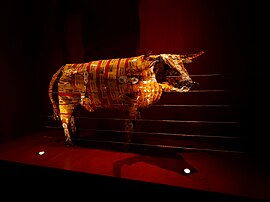
Pisupo Lua Afe (Corned Beef 2000) is a pop art sculpture created by the New Zealand creative person Michel Tuffery in 1994. It is the offset in a series of tin animals, made from the packaging of foods common in Samoa. Addressing his Samoan heritage, neocolonialism and the distress of indigenous peoples in the Pacific, it is one of his most celebrated works.
"Does foreign intervention encourage cultural and economic independence - or dependence?" was the question posed past Tuffery when the sculpture was unveiled at the exhibition Bottled Bounding main, curated past Jim Vivieaere, at Metropolis Gallery Wellington in 1994. A pop art sculpture unique to the predominately Western art motility, Pisupo Lua Afe consists of a bull fabricated of hundreds of tinned corned beef cans held together by rivets. The artwork addresses the plight of traditional Samoan cuisine and health due to the introduction of pisupo- unhealthy, commercial tinned food- by Europeans. [a] Now a major office of Samoan civilization, foreign-produced pisupo such every bit corned beefiness has go ubiquitous across their communities both in Samoa and beyond the diaspora, with gifting of these items customary at weddings and birthdays. This unhealthy dependence on predominately New Zealand, Australian and American companies is inherently neocolonial in nature, showing how much lobbying power New Zealand still has in Samoa nigh threescore years since independence.[1]
Tuffery wanted to show Samoans as being nonetheless total of courage, despite the influence wielded by white-owned strange food manufactures. The bull is both representative of the animal corned beef comes from (and the ecology impact it has in Samoa, an especially climate crisis-vulnerable country), and the strength of the Samoan people to overcome colonialism. The work is on display at Te Papa Tongarewa, New Zealand'southward national museum and the 17th-most visited art museum in the world.[2]
Description [edit]
Taking an influence from pop fine art, the work consists of a balderdash made of hundreds of tinned corned beef cans held together by rivets. Pisupo Lua Afe concerns New Zealand'due south questionable trade practices across the South Pacific[ citation needed ], where information technology wields significant influence every bit a regional power. For Tuffery, corned beef (or pisupo in Samoan)[b] is representative of the loftier-fat, unhealthy foods foreign companies have introduced to Samoa. These foods accept led to unduly high incidences of diabetes and eye disease in Pacific Island populations, as diets formerly high in locally grown fruits and vegetables, seafood, coconut milk and flesh, have given way to cheap, imported foodstuffs. Neocolonialism is addressed here via the choice of corned beefiness; later on Samoa'due south independence from New Zealand in 1962, food businesses in the latter country accept greatly contributed to an unhealthy diet that many Samoans have fallen victim to.[iii] Not merely is corned beef a favorite food source in the Islands, information technology has also become a ubiquitous office of the ceremonial gift economy.[4]
Such brands of corned beef Tuffery aimed to criticise included Pacific, an Australian make owned by American conglomerate Kraft-Heinz which specifically markets itself towards Pacific Islanders. Information technology has been maligned for doing so, and also for its apply of name "Pacific" as misleading people into thinking the brand is Pasifika-owned. Even so, the Fijian-made brand Aureate State was the one used in the art, but since the introduction of European cattle to the pacific has degraded Pacific landscapes however, using a non-European brand did not affect the authority of the message Tuffery was conveying.[5]

The symbolism of the bull is used to portray both the animate being from which corned beef is derived, and the force and courage of the Samoan people to overcome colonialism. The latter of which was both a hallmark of New Zealand'southward colonial dominion in Samoa later on gaining it from German dominion as a League of Nations mandate, and still affects Samoan New Zealanders resident in the country today. Tuffery was also interested in the affect of the introduction of cattle to New Zealand and the Pacific Islands; the hard, abrasive can is used in the artwork besides to symbolise the damage these industries have. The endemic plants, landscapes and waterways of these countries are nevertheless being negatively affected by this colonial decision. Additionally, Tuffery was interested in how processed meat products such equally corned beefiness have negatively impacted traditional Samoan food production, and accept led to a "throw-away mentality".[vi]
Reception and continuation of serial [edit]
Pisupo Lua Afe (Corned Beef 2000) has been the subject of wide pop and disquisitional acclamation. Critics commended the originality of Tuffery to use popular art in a way that addressed racism and economic dependence, and how the aesthetic simplicity of the piece of work meant it could appeal towards children, every bit well every bit adults. The appeal to children persists; an episode of the TVNZ 7 children's serial Tales From Te Papa was centered on the artwork, and the artwork is located near the Samoan-themed children's area of Te Papa.[7]
In her writeup for the Christchurch Art Gallery, curator Jennifer Hay described the work as a "wry socio-political message" concerning the place of strange imported goods in Samoa as function of the larger presence of colonialism in the Pacific Islands.[viii] The work has become maybe Tuffery's best known, and is considered an important work of both Popular art and Kiwiana.[ix]
The Povi Pisupo series [edit]

Michel Tuffrey with two boosted bulls from the Pisupo Lua Afe series
The positive reception to Pisupo Lua Afe encouraged Tuffery to create more brute-based works fabricated out of nutrient tins. With more bulls to piece of work with, Tuffery decided to create a piece of performance art entitled Povi tau vaga (The bull claiming), for the Wellington opening of the exhibition for the continued Povi Pisupo series. Working with artist Patrice Kaikilekofe, his bulls, accompanied by Samoan drumming and dancing, were wheeled along a route through central Wellington to the Urban center Gallery in Te Ngākau Civic Square, where a "bullfight" commenced. This fourth dimension, they included a wooden frame and wheels, and so information technology could exist transported more than easily. Fireworks and Christmas tree lights were placed inside these powered bulls, showing a frightening mechanical brandish of color. This functioning was widely pop, prompting Tuffery to repeat the event for both the Christchurch Art Gallery and the Queensland Art Gallery in Brisbane in 1999, both times with the new bull Povi Christkeke (Christchurch Bull).[x] In Brisbane, the bulls were raced effectually inside the gallery while fireworks exploded, surprisingly causing no damage; this fiery spark is said to sum up Tuffery as a groundbreaking artist.[eleven]

"There was fire, in that location was low-cal..." Tuffrey's Wellington bullfight in process, 1996.
References [edit]
Notes [edit]
- ^ Tinned food was introduced to Samoa over a hundred years agone, but only in the form of pea soup ab initio. Therefore, the word for tinned food was "Pisupo", a Samoanised version of the English for "Pea Soup". The name became ubiquitous for all tinned food equally more and more varieties were introduced to the country, and now information technology is more or less confined to tinned meat.
- ^ Tinned nutrient was introduced to Samoa over a hundred years ago, merely only in the form of pea soup ab initio. Therefore, the word for tinned food was "Pisupo", a Samoanised version of the English for "Pea Soup". The name became ubiquitous for all tinned food every bit more than and more varieties were introduced to the country, and at present it is more than or less bars to tinned meat.
- ^ "Michel Tuffery, Pisupo Lua Afe (commodity)". Khan University . Retrieved 2021-07-21 .
- ^ "Loading... | Collections Online - Museum of New Zealand Te Papa Tongarewa". collections.tepapa.govt.nz . Retrieved 2021-07-21 .
- ^ "Michel Tuffery, Pisupo Lua Afe (article)". Khan Academy . Retrieved 2021-07-21 .
- ^ Pisupo Lua Afe (Corned Beef 2000) - Tales from Te Papa episode 15 , retrieved 2021-07-22
- ^ Simes, Miranda (2018-05-01). "Can Transmission: Using Corned Beefiness to Talk About Cultural Change". The Morningside Review. 14. ISSN 2333-6536.
- ^ June 2005, 15. "Povi Christkeke past Michel Tuffery". christchurchartgallery.org.nz . Retrieved 2021-07-21 .
{{cite spider web}}: CS1 maint: numeric names: authors list (link) - ^ Pisupo Lua Afe (Corned Beef 2000) - Tales from Te Papa episode 15 , retrieved 2021-07-22
- ^ Simes, Miranda (2018-05-01). "Can Transmission: Using Corned Beef to Talk Most Cultural Modify". The Morningside Review. fourteen. ISSN 2333-6536.
- ^ June 2005, 15. "Povi Christkeke by Michel Tuffery". christchurchartgallery.org.nz . Retrieved 2021-07-22 .
{{cite web}}: CS1 maint: numeric names: authors list (link) - ^ June 2005, 15. "Povi Christkeke by Michel Tuffery". christchurchartgallery.org.nz . Retrieved 2021-07-21 .
{{cite web}}: CS1 maint: numeric names: authors list (link) - ^ Queensl, ©; Art, Art Gallery | Gallery of Modernistic (2013-03-01). "Twentieth anniversary of APT: Michel Tuffery's raging bull". QAGOMA Blog . Retrieved 2021-07-22 .
{{cite web}}: CS1 maint: numeric names: authors list (link)
Source: https://en.wikipedia.org/wiki/Pisupo_Lua_Afe_(Corned_Beef_2000)
Belum ada Komentar untuk "Pisupo Lua Afe (Corned Beef 2000) Ap Art History"
Posting Komentar